
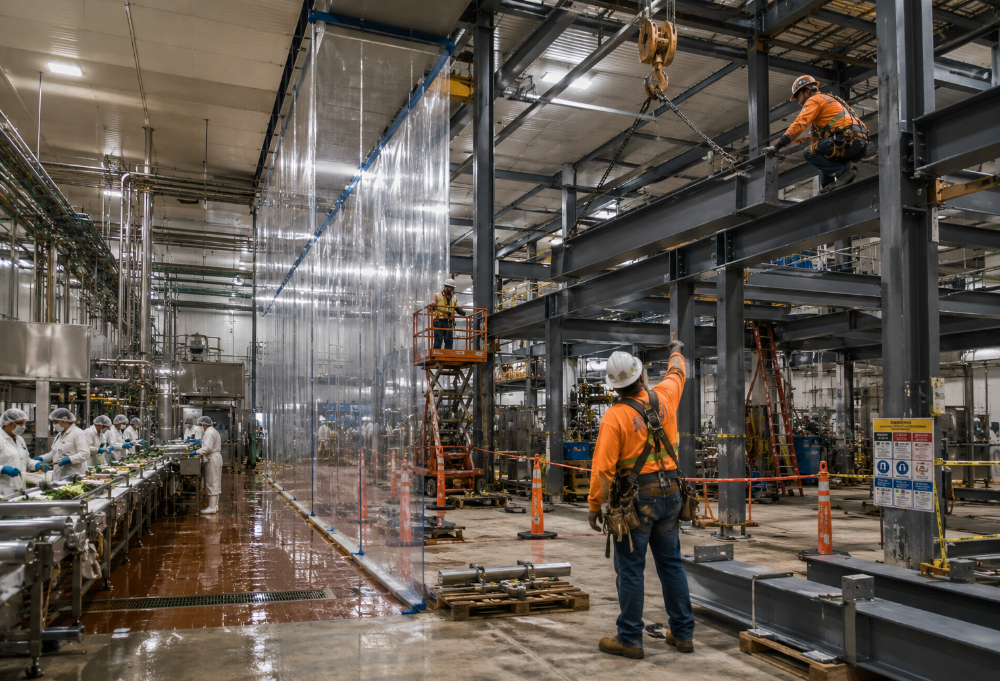
Retrofitting a food processing facility is one of the most complex undertakings in industrial construction. Unlike a vacant warehouse or an idle commercial property, an active food processing plant never truly stops. Conveyors keep moving, refrigeration systems keep humming, and production quotas keep demanding attention. When structural steel retrofits are required in this kind of environment, the margin for error shrinks considerably. For facilities across the Central Valley, including those in Visalia, CA and the surrounding agricultural corridor, this challenge is a routine reality.
Understanding how to plan, coordinate, and execute these projects safely is not just a matter of construction expertise. It is a matter of protecting workers, preserving product integrity, maintaining regulatory compliance, and keeping a business operational throughout the entire process.
1. Start With a Thorough Pre-Construction Assessment
Before a single beam is cut or a new column is positioned, a comprehensive pre-construction assessment must take place. This means evaluating the existing structural steel framework in detail, understanding load-bearing relationships, and mapping out every utility line, drainage run, and equipment anchor point that could be affected by the proposed modifications.
In agricultural processing plant construction, this step carries extra weight. Food facilities are built with strict hygiene standards, specialized drainage systems, and carefully calibrated airflow in mind. Any structural modification has the potential to disrupt these systems if the planning phase is not meticulous. Steel erection crews need to understand not just what they are building, but what already exists around them.
A thorough assessment also gives contractors the opportunity to identify scheduling windows. Most food processing operations have predictable slowdowns, whether it is a seasonal lull, a planned maintenance shutdown, or a shift change with reduced staffing. Aligning the most disruptive phases of structural steel retrofits with these windows reduces risk and minimizes interference with production.
2. Establish Strict Contamination Control Protocols
Food safety is non-negotiable in any active processing environment. During commercial steel building modifications, the construction zone must be treated as a potential source of contamination. Metal shavings, welding fumes, dust from concrete cutting, and debris from overhead work all pose serious risks to exposed food products, packaging surfaces, and sanitary equipment.
Containment barriers are essential. These typically include physical partitions made from food-safe materials, negative air pressure systems to direct airborne particles away from production areas, and clearly defined access routes that prevent construction personnel from crossing into active production zones without proper sanitation protocols.
Contractors working in Central Valley food facilities are often required to meet standards set by organizations such as the Food Safety Modernization Act (FSMA) or individual client safety programs. This means construction teams need to be trained not only in their trade skills but also in the food safety expectations of the facility. Steel erection crews, ironworkers, and site supervisors all need to understand how their work intersects with the food safety responsibilities of the plant.
Personal protective equipment requirements may also differ from standard construction sites. Hard hats, gloves, and safety glasses are givens, but some facilities also require hair nets, beard covers, and specific footwear to reduce the risk of foreign material contamination.
3. Coordinate Closely With Facility Operations Teams
One of the most critical factors in successfully completing structural steel retrofits within an active food processing facility is the relationship between the construction team and the facility’s operations staff. These two groups often operate in fundamentally different ways. Construction crews work in phases, deal with unpredictability, and adapt to changing site conditions. Operations teams run on schedules, optimize for throughput, and measure success in units produced per hour.
Bridging this gap requires consistent, structured communication. Weekly coordination meetings, shared project timelines, and clear escalation procedures for unexpected issues all contribute to smoother execution. When a piece of industrial steel fabrication requires temporary relocation of a production line, operations management needs adequate notice to adjust staffing and output plans. When a structural steel retrofit requires a utility shutdown, the timing must be agreed upon well in advance.
In Visalia, CA and throughout the broader Central Valley agricultural sector, many food processing plants operate around the clock during peak season. Contractors who understand this reality bring solutions to the table rather than simply presenting constraints. Phased construction plans, modular steel assembly completed off-site before installation, and rapid-installation systems all help reduce the amount of time the construction process intrudes on active operations.
4. Prioritize Worker Safety in a Dual-Hazard Environment
Active food processing facilities present a unique safety challenge because construction workers must navigate hazards from two distinct environments at once. Standard construction risks, such as working at height, operating heavy equipment, managing electrical hazards, and handling heavy steel members, are compounded by the operational hazards of the facility itself. These can include wet floors from washdown cycles, moving forklifts and pallet jacks, pressurized lines, and temperature extremes in refrigerated or cooking zones.
A robust site-specific safety plan is mandatory. This plan should be developed in collaboration with both the construction contractor and the facility’s safety officer. It needs to address exclusion zones, lockout/tagout procedures for facility equipment adjacent to the work area, fall protection systems appropriate for the specific overhead environment, and emergency response protocols that account for the complexity of the combined site.
Steel erection in particular demands careful planning when it occurs near active production. Overhead lifts using cranes or forklifts must be coordinated to ensure that loads are never swung over occupied production areas. Rigging plans should be reviewed and approved before each major lift. All ironworkers involved in the steel erection process should be current with their certifications and familiar with the specific limitations of the facility environment.
Regular safety briefings, sometimes called toolbox talks, keep both construction and facility personnel aligned on daily hazards and procedural expectations. A safety culture that treats the construction zone and the production floor as a shared responsibility tends to produce better outcomes for everyone involved.
5. Leverage Prefabrication and Off-Site Industrial Steel Fabrication
One of the most effective strategies for reducing disruption during structural steel retrofits in active facilities is maximizing the use of off-site industrial steel fabrication. When structural components are cut, drilled, welded, and finished at a fabrication shop before arriving at the job site, the amount of time spent performing those tasks inside the active facility drops significantly.
This approach is especially valuable in the Central Valley, where agricultural processing plant construction often involves tight timelines tied to harvest seasons or contractually mandated production schedules. A steel fabricator that can deliver precisely engineered components ready for rapid installation gives the general contractor a significant advantage in scheduling and execution.
Prefabricated components also reduce the volume of hot work, specifically cutting and welding, performed inside the facility. This directly reduces contamination risk from fumes and sparks, simplifies the permitting process for hot work inside a food environment, and shortens the duration of production disruptions associated with any given phase of commercial steel building modifications.
For complex projects involving multiple bays, mezzanine structures, or large-scale equipment supports, modular assembly strategies can allow entire structural sections to be assembled off-site and installed in a fraction of the time it would take to build them in place. The upfront investment in engineering and coordination pays off through reduced on-site labor hours and faster return to full production capacity.
Keeping Operations Moving While the Building Evolves
Structural steel retrofits in active food processing environments are never simple, but they are absolutely achievable with the right planning, communication, and technical execution. Facilities across the Central Valley and in Visalia, CA have successfully completed major commercial steel building modifications without sacrificing food safety, worker protection, or operational continuity. The key is treating every phase of the project, from the initial assessment through final steel erection, as a collaborative effort between construction professionals and the people who run the facility every day. When those two groups work as partners, the result is a stronger, more capable facility built without missing a beat.
Need a Steel Fabricator & Welding Shop In Visalia, CA?
Suburban Pipe & Steel, Inc. DBA Flint Construction. in Visalia, California, doing business as Flint Construction, has been family owned since 1957. We truly understand steel buildings. We design, fabricate, and install all phases of pipe and steel structures for every industry. Contact us today to find out more about our services, rates, and to schedule a consultation. You can even fax us your drawings so we can have a better idea of your vision. We look forward to exceeding your expectations.